Planning is a first-class stage, not a preamble you lose in chat history.
Polystro includes explicit planning surfaces because multi-agent development breaks down when intent, constraints, and review criteria stay informal. Plan Mode and Ideation Center turn that work into durable stages.
Plan Mode
Plan Mode lets a session produce a structured implementation plan instead of jumping directly into execution. The plan is rendered as a reviewable artifact with a clear title, steps, risks, and acceptance criteria when available.
Draft generation
The session can generate a first plan draft and show a dedicated draft/revision state instead of burying that step inside the transcript.
Open artifact
The plan can be opened as markdown so it behaves like a real working artifact.
Approval gate
Plans can be approved, rejected, or revised before implementation begins.
Execution launch
Once approved, the plan can launch implementation in the same session or hand off into another session or CLI.
Revision and Review Loop
The point of Plan Mode is not only producing a document. It is giving you a structured point where you can push back before build work starts. That is especially useful when the agent is moving fast but the spec is still fuzzy.
Why this matters
Ideation Center
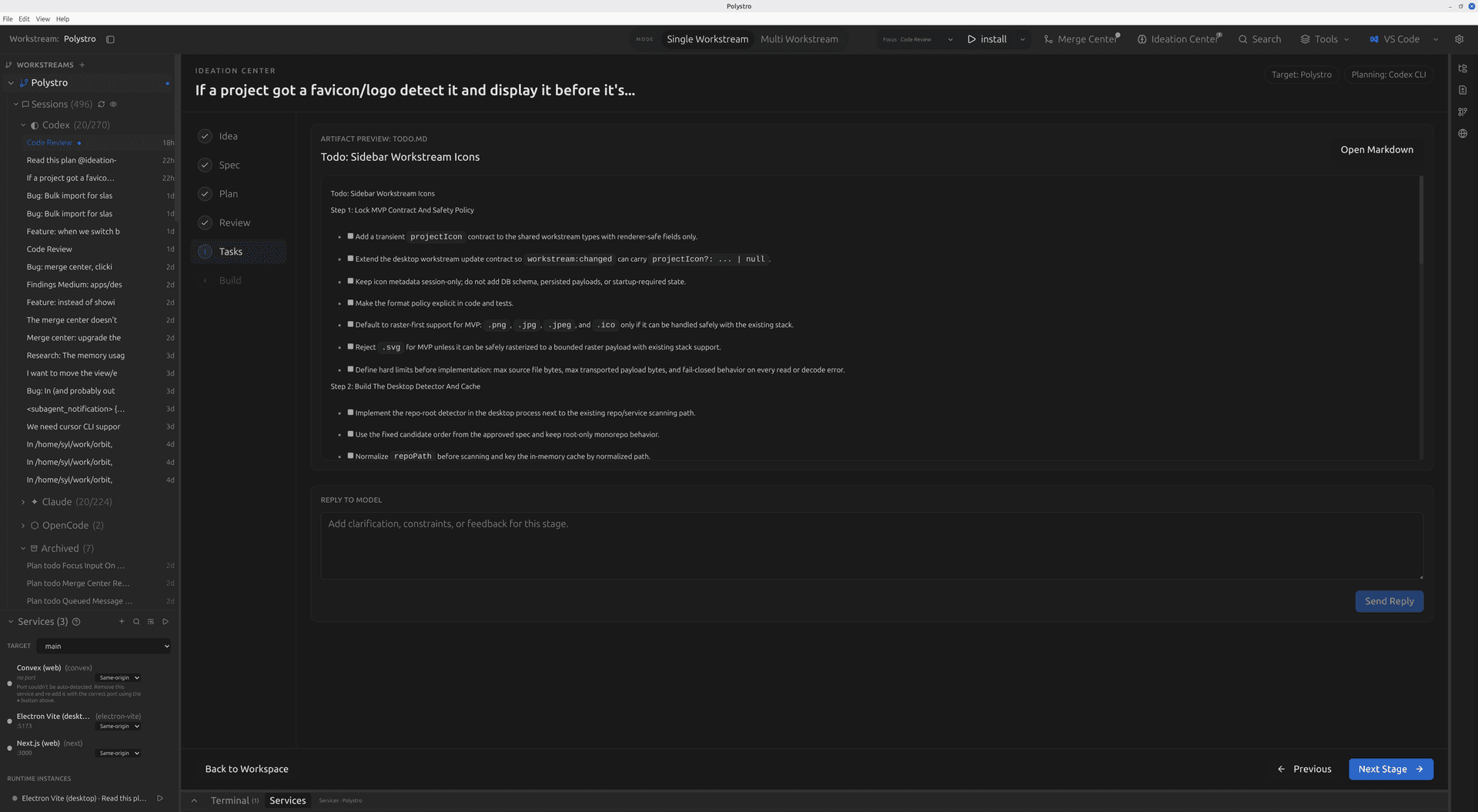
Ideation Center is a broader staged flow for idea, spec, plan, review, tasks, and build. It is meant for shaping work before the main coding session starts, especially when you are turning a vague request into a more operational plan.
Build Handoff
Both Plan Mode and Ideation Center end at the same practical question: how does structured thinking hand off into actual build work? Polystro answers that by launching implementation back into the normal session model instead of creating a separate disconnected tool.